What the Locks Were Built to Move
The Miami and Erie Canal lock system in Miami County — the engineering of a lift lock, which locks survive in legible condition, and what the canal moved through this section of Ohio in its operational decades.
A Nineteenth-Century Lift Through Miami County
The Miami and Erie Canal threaded north from Cincinnati to Toledo across 274 miles of Ohio terrain, and the stretch through Miami County was among its more commercially animated sections. Tipp City, Troy, and Piqua each sat on or near the line; grain, pork, and manufactured goods moved south toward the Ohio River markets while lime, coal, and finished hardware came north. The canal's operational peak ran roughly from the late 1840s through the 1870s, before the railroads stripped it of freight and left the earthworks to silt and collapse.
The engineering problem the canal solved was simple to state and expensive to build: the Miami Valley rises as you move north. A lift lock — a chamber with mitered timber gates at each end, sealed tight enough to hold a pool — raised or lowered a loaded boat between two reaches of canal water sitting at different elevations, typically a lift of six to ten feet per chamber. Boats entered, the trailing gates closed, the upstream gates cracked to admit water, and the pool equalized. The whole operation took ten to fifteen minutes with a practiced crew. A flight of locks — two or more chambers set closely together — could stack several lifts in quick succession where the topography demanded it. Lock chambers on the Miami and Erie were built to accommodate boats roughly ninety feet long and fifteen feet wide, limiting cargo loads to around seventy-five tons.
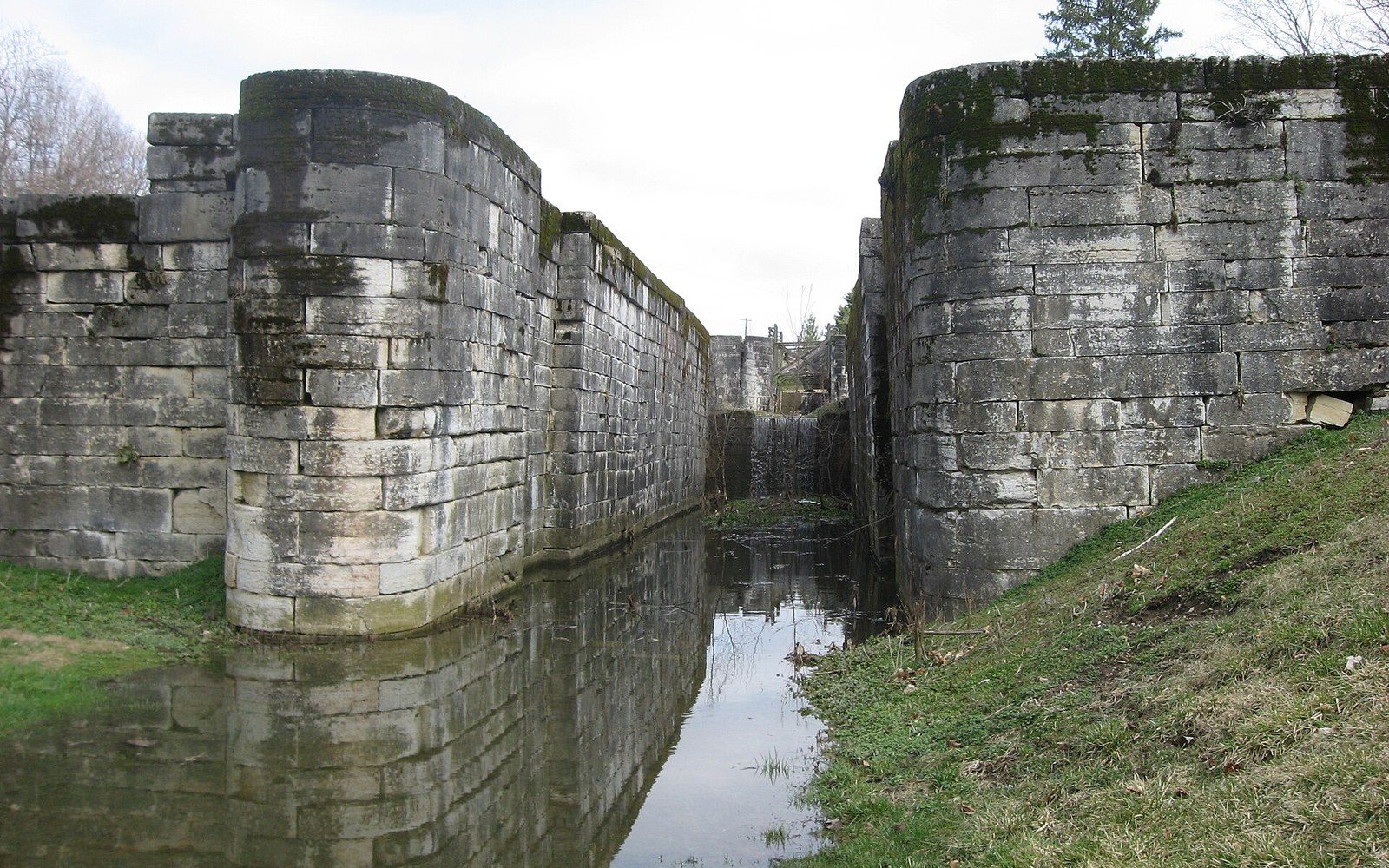
Lockington, a small settlement just north of Piqua, in southern Shelby County, holds the most visible surviving evidence of this infrastructure. The Lockington Locks comprise a flight of six lift locks on the Great Miami River feeder stretch — among the best-preserved lock sequences remaining in Ohio. The Ohio History Connection recognizes the site, and the stonework — cut limestone laid without mortar — remains largely intact along several chambers. Standing at the upper lock and looking down the flight, the staircase logic of the engineering reads directly in the stone: each successive chamber drops the canal grade toward the river level below.
The masonry at Lockington is Silurian limestone quarried locally, a material that proved durable precisely because the canal builders had incentive to build well. A lock failure meant halting traffic and losing revenue; owners of the boat-carrying trade were not patient creditors. The chamber walls taper slightly outward at the base to resist the lateral pressure of saturated embankment soil — a detail visible in the surviving courses.
What moved through these locks was unglamorous in aggregate and consequential in sum. Miami County's agricultural production in the canal decades leaned heavily on wheat and corn, and Piqua developed textile manufacturing early enough to ship finished goods south before the railroads arrived. At Tipp City — then called Tippecanoe City — the canal ran through the commercial core, and the town's brick-fronted commercial streetscape still reflects the density of trade that followed the water. Troy's position on the Great Miami gave it a parallel but distinct relationship to the canal: the river itself served barge traffic on flood-high water, and the canal ran nearby as a more controlled alternative.
By the 1880s the commercial argument for the locks had collapsed. Railroad freight rates undercut canal tolls, and the state of Ohio, which had built the canal and later leased it to private operators, allowed the infrastructure to decay. The great flood of March 1913 — which sent the Great Miami to record peak discharge — destroyed or buried much of what remained of the working canal. What survived at Lockington did so partly because the flight sat on relatively high ground and the limestone construction resisted the scouring that took out earthen towpaths and wooden gates elsewhere in the valley.
The locks at Lockington now function as a legible ruin: not restored to working order, not interpreted as a museum, but readable by anyone who understands what a lock chamber is built to do.