The Johnston Farm and the Canal It Sat On
The Johnston Farm in Piqua is both a documented agricultural operation and the site of surviving Miami and Erie Canal infrastructure — the lockkeeper's house, the working section of canal, and the historical record the state maintains there.
A working farm north of Troy preserved the canal that once ran beside it — and the state keeps both legible.
Canal and Farm, Together
The Johnston Farm sits on the north edge of Piqua, roughly twelve miles north of Troy along the Great Miami River valley. What survives there is not a reconstruction: it is a documented agricultural property from the early nineteenth century, preserved as a state historic site, with a functioning section of the Miami and Erie Canal — the waterway that connected Cincinnati to Toledo — still visible and seasonally operable alongside it.
The canal reached Piqua in the 1830s. By then the Johnston family had been farming the property for decades. John Johnston, who served as a federal Indian agent for the Miami and Shawnee peoples across the early part of the century, had established the farm before the canal corridor was surveyed. The canal was built beside him, not before him — which is part of what makes the site unusual. Most canal infrastructure ran through land opened by the canal's own traffic; here the sequence ran the other way.
What the Infrastructure Looks Like
The surviving canal section at Johnston Farm preserves roughly a mile of the original channel, still holding water. A lift lock — a chamber with gates at each end that raised or lowered boats between reaches of water at different elevations — remains on the property in workable condition. Wooden canal boats have been operated on the channel during the site's interpretive seasons, making this one of the few places in Ohio where the mechanical logic of canal transit can be observed in physical form rather than illustrated from a diagram.
The lockkeeper's house, a modest Federal-style structure, stands adjacent to the lock. Its placement is functional rather than ornamental: the keeper needed a direct sightline to the lock gates and immediate access when boats arrived. The structure documents a job category that disappeared entirely when the canal was commercially abandoned — the Miami and Erie carried traffic into the early twentieth century, until the 1913 flood, and was formally abandoned in stages afterward, its revenue undercut first by the railroads and then by the floods that kept damaging its earthworks.
The farmhouse and associated outbuildings give the site a second documentary layer, separate from the canal record. The main house dates to 1815 and is listed on the National Register of Historic Places, which documents both its architectural character and its period of significance. The property is managed by the Ohio History Connection, which maintains the physical structures and oversees the interpretive record.
The Canal's Place in the Valley
The Miami and Erie Canal was not incidental to the economy of what is now Miami County. Grain moving north toward Toledo and manufactured goods coming south toward Cincinnati passed through Piqua and Troy on water before the railroads made the canal redundant. Tipp City, then called Tippecanoe City, grew as a canal town; its commercial-era brick streetscape along the river corridor reflects traffic that the canal generated. The lock system in Miami County required continuous human management — gate tenders, lockmasters, maintenance crews — a form of infrastructure labor that left almost no documentary record beyond payroll and property lists.
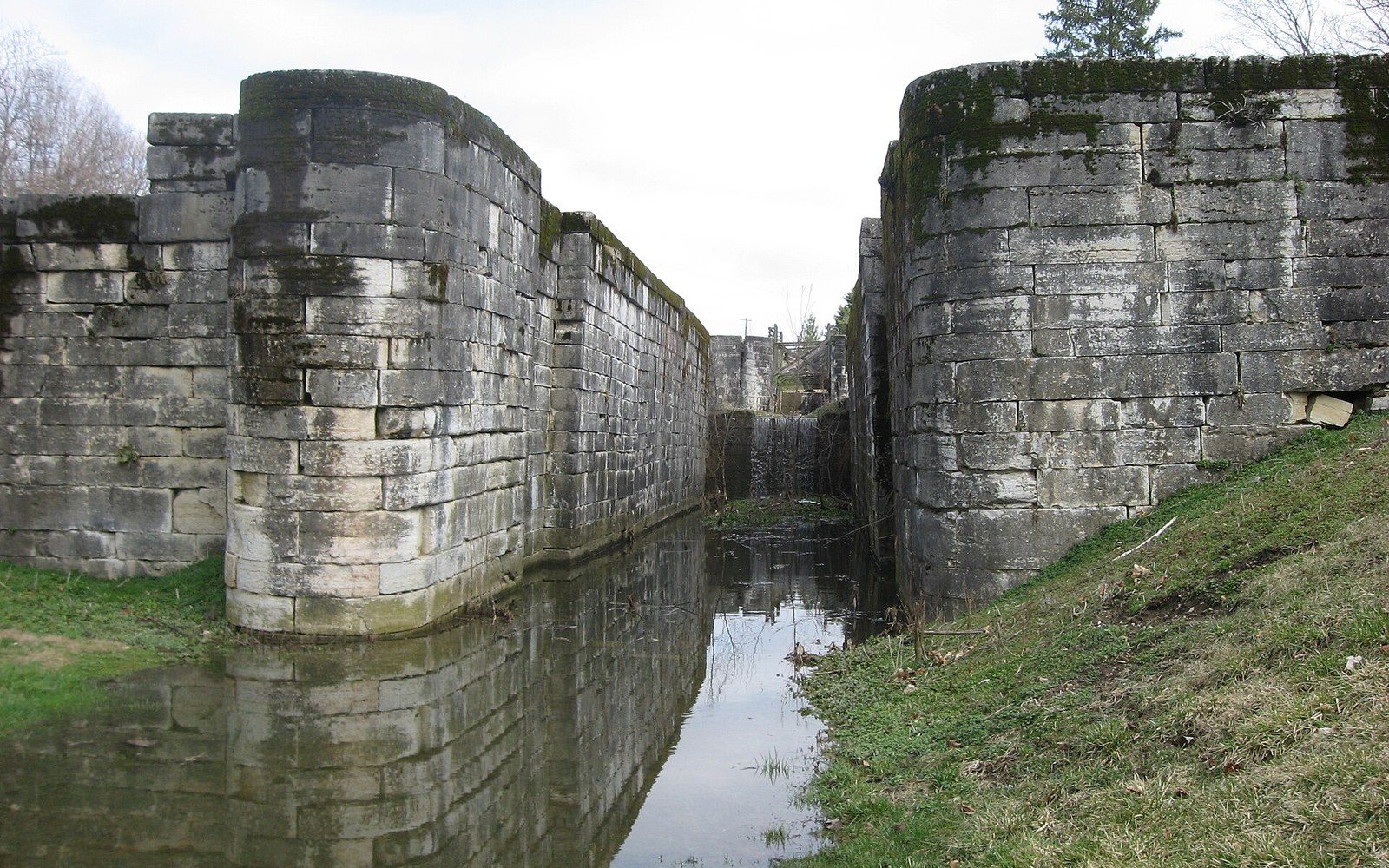
What the Johnston Farm preserves, partly by accident and partly through deliberate state management, is a legible cross-section of that system. The channel holds water. The lock gates move. The lockkeeper's house stands where it was built to stand. None of that is common; most of the Miami and Erie's alignment is either built over, farmed into, or reduced to a dry earthen trace readable only from aerial survey.
For readers interested in the canal as an engineering object rather than a heritage attraction, the Johnston Farm offers something specific: infrastructure at original scale, in original position, with enough surviving context to understand why each element was placed where it was.